
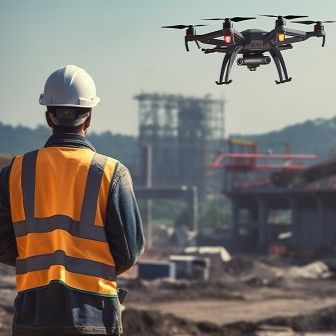
Twenty years ago, obtaining aerial footage of a construction site, facility, or infrastructure project often required hiring a helicopter and pilot. Today, a drone launched from the back of a pickup truck can capture high-resolution images, videos, and data for a fraction of the cost.
The rise of drone technology has transformed industries ranging from construction and utilities to telecommunications, agriculture, and surveying. Drones help businesses improve efficiency, reduce costs, and keep workers out of dangerous situations.
However, while drones offer significant safety advantages, they also introduce new hazards that employers and operators must understand. A drone may be a powerful tool, but it is still an aircraft, and aircrafts come with risks and responsibilities.
How Drones Are Transforming Workplace Operations
Drones, also known as Unmanned Aircraft Systems (UAS), have revolutionized the way many organizations perform inspections, surveys, and data collection.
Common workplace applications include:
- Roof inspections
- Construction site monitoring
- Surveying and mapping
- Cell tower inspections
- Utility and powerline inspections
- Infrastructure assessments
- Environmental monitoring
- And, photography and videography
One of the greatest benefits of drone technology is its ability to keep workers safely on the ground while still allowing organizations to access difficult, elevated, or hazardous locations.
Instead of climbing a roof, scaling a tower, or entering a potentially dangerous area, workers can often gather the same information remotely using a drone.
From a safety perspective, reducing employee exposure to fall hazards and other high-risk activities is a major advantage.
What Is a Workplace Drone?
Most workplace drones are considered Unmanned Aircraft Systems (UAS). Despite the name, these aircrafts are not fully autonomous.
In most cases, a trained operator controls the drone using a remote controller while monitoring a live video feed transmitted from onboard cameras.
Many systems also incorporate advanced technologies such as:
- GPS navigation
- Obstacle avoidance systems
- Automated flight paths
- High-definition cameras
- Thermal imaging
- Virtual Reality (VR) viewing systems
- And, augmented Reality (AR) displays
While these technologies improve performance and efficiency, they also create new safety considerations.
The Top Workplace Drone Hazards
Like any piece of equipment, drones introduce risks that must be properly managed.
Hazard Number 1: Falling Objects and Drone Crashes
Perhaps the most obvious hazard is the possibility of a drone falling from the sky.
A drone may crash due to:
- Mechanical failure
- Battery depletion
- Strong winds
- Software malfunctions
- Signal loss
- Or, pilot error
When equipment weighing several pounds falls from hundreds of feet in the air, serious injuries and property damage can occur.
Hazard Number 2: Property Damage
Drone crashes can cause significant damage to:
- Vehicles
- Buildings
- Equipment
- Powerlines
- Infrastructure
- Or, construction materials
A single accident can result in costly repairs, project delays, and liability concerns. In some cases, a drone may strike people on the ground, creating additional safety risks.
Hazard Number 3: GPS Signal Loss
Modern drones rely heavily on GPS systems for navigation and positioning.
When GPS signals become weak or unavailable, drones may:
- Drift unexpectedly
- Become unstable
- Fail to return home
- Or, operate unpredictably
Urban environments, dense structures, weather conditions, and electromagnetic interference can all contribute to GPS issues.
Hazard Number 4: Aircraft Collisions
One of the most serious risks associated with drone operations is the potential for collisions with manned aircrafts. Airplanes and helicopters always have the right-of-way.
A collision between a drone and a manned aircraft could have catastrophic consequences for passengers, crew members, and people on the ground. This is one of the primary reasons the Federal Aviation Administration (FAA) regulates commercial drone operations and airspace use.
Hazard Number 5: Propeller Injuries
Drone propellers can spin at thousands of revolutions per minute.
While they may appear harmless, these rapidly rotating blades can cause:
- Cuts
- Lacerations
- Eye injuries
- Or, hand injuries
Improper handling during launch, landing, maintenance, or recovery operations can quickly result in injuries.
FAA Requirements for Drone Operators
Many people assume anyone can purchase a drone and immediately begin conducting commercial operations.
While recreational drone use is relatively accessible, commercial operations must comply with FAA requirements.
Generally, drone operators must:
- Be at least 16 years old
- Read, write, speak, and understand English
- And, be physically and mentally capable of safely operating a drone
Commercial operators must also meet additional FAA requirements before conducting business-related flights.
Key Rules for Commercial Drone Operations
The FAA has established regulations designed to protect both airspace users and people on the ground.
Some of the most important requirements include:
- Holding a Remote Pilot Certificate
- Registering the drone
- Operating drones weighing less than 55 pounds
- Maintaining visual line of sight
- Flying at or below 400 feet
- Flying below 100 miles per hour
- And, yielding to all manned aircraft
These rules function much like traffic laws for the sky. Following them helps prevent accidents, injuries, and regulatory violations.
Understanding the Different Types of Drones
Not all drones are created equal. Different drone designs serve different operational purposes.
Multi-Rotor Drones
Multi-rotor drones are the most common type of drone used in workplaces today.
They are widely used for:
- Photography
- Videography
- Site inspections
- And, building assessments
Their ability to hover and maneuver precisely makes them extremely versatile.
The primary drawback is limited battery life due to the constant power required to remain airborne.
Fixed-Wing Drones
Fixed-wing drones resemble traditional airplanes.
They are ideal for:
- Mapping projects
- Surveying
- Large-area inspections
- And, long-distance flights
Because they generate lift more efficiently, they can remain airborne significantly longer than many multi-rotor systems.
Single-Rotor Drones
Single-rotor drones resemble miniature helicopters.
Advantages include:
- Greater flight efficiency
- Longer flight times
- And, higher payload capacity
However, their larger rotor systems create additional hazards and require advanced operating skills. These systems are generally not recommended for inexperienced operators.
Hybrid Drones
Hybrid drones combine characteristics of both multi-rotor and fixed-wing aircraft.
Benefits include:
- Vertical takeoff and landing
- Long-distance travel
- Hovering capabilities
- And, enhanced versatility
Many organizations involved in delivery services and advanced logistics are investing heavily in hybrid drone technology.
Virtual Reality vs. Augmented Reality in Drone Operations
Modern drone systems increasingly incorporate immersive technologies.
Virtual Reality (VR)
VR goggles allow operators to experience a first-person view from the drone.
Benefits include:
- Enhanced situational perspective
- Improved navigation
- And, greater immersion
However, VR creates a significant challenge. When operators are fully immersed in the drone's perspective, they may lose awareness of their physical surroundings, including:
- Nearby vehicles
- Workers
- Equipment
- Or, ground-level hazards
Additionally, video transmission delays, known as latency, can contribute to navigation errors and crashes.
Augmented Reality (AR)
Unlike VR, AR overlays information onto the operator's real-world view.
This allows operators to maintain awareness of their surroundings while still receiving critical flight data.
While AR may be less immersive than VR, it often provides greater situational awareness, a critical component of safe drone operations.
What Happens When a Drone Crashes?
Not all drone incidents end with a simple equipment repair.
Certain accidents may require reporting to the FAA, particularly when they involve:
- Serious injuries
- Significant property damage
- Or, regulatory violations
The FAA may also inspect:
- Operational records
- Pilot certifications
- Training documentation
- Flight logs
- And, equipment maintenance records
Commercial drone operations involve more than simply owning equipment. Operators are responsible for maintaining compliance and ensuring safe flight practices.
Best Practices for Safe Drone Operations
Organizations using drones should develop procedures that address both operational and safety requirements.
Some key best practices include:
- Follow manufacturer recommendations
- Conduct pre-flight inspections
- Monitor weather conditions
- Maintain visual line of sight
- Stay alert for aircraft
- Establish exclusion zones when appropriate
- Protect workers from propeller hazards
- Maintain battery management procedures
- Train operators thoroughly
- And, report incidents when required
Most importantly, operators should never become complacent.
Conclusion
Drones have transformed modern workplaces by improving efficiency, reducing costs, and allowing workers to inspect dangerous areas without exposing themselves to unnecessary risks.
However, drones are still aircrafts. They can crash, cause injuries, damage property, and create serious hazards when operated improperly.
The safest drone operations combine technology, training, regulatory compliance, and situational awareness. By understanding the risks and following established safety practices, organizations can take full advantage of drone technology while protecting both workers and the public. Because at the end of the day, the safest drone flight is the one that lands exactly where it was supposed to.

Brooklyn Nice
Brooklyn Nice is a Content Development Specialist at JJ Safety, where she creates engaging, OSHA-focused safety content, training materials, and educational resources for workers and employers. She has earned her OSHA 10 Certification, providing her with a strong foundation in workplace safety principles and industry best practices.